

3D Primitive
Updated: 15 Sep 2026
Generate a 3D primitive as a mesh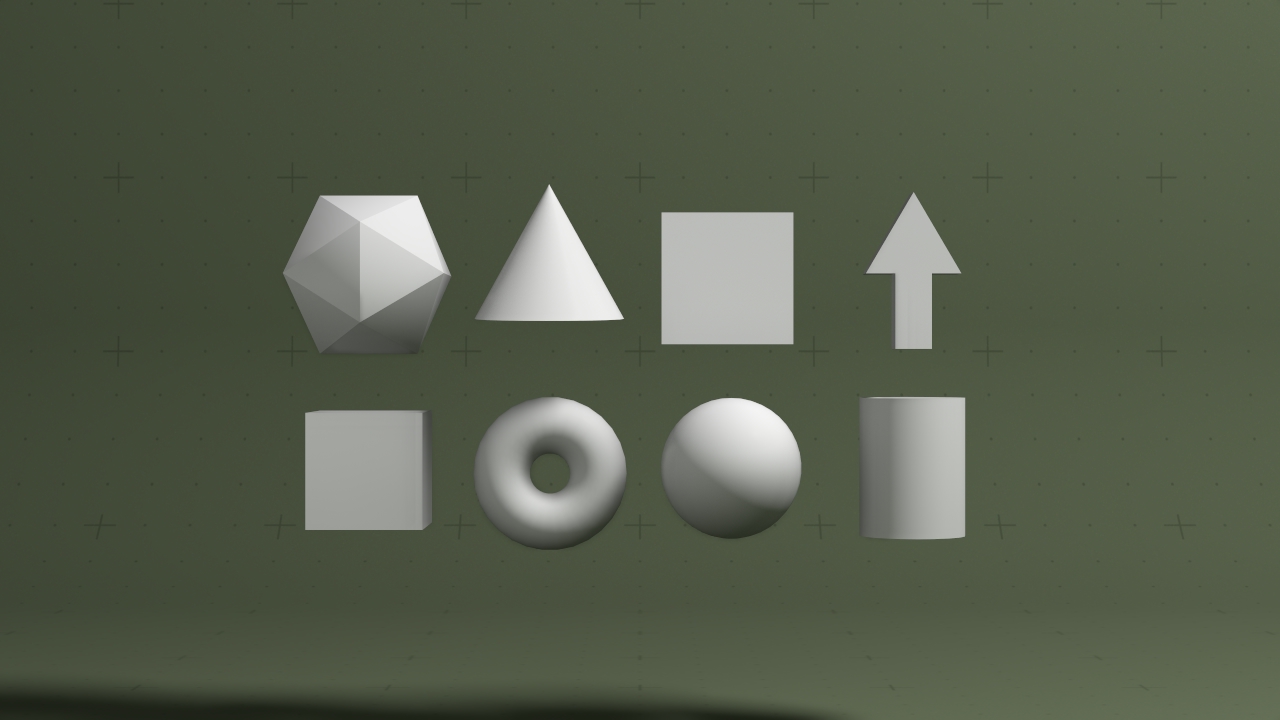
Updated: 15 Sep 2026
Generate a 3D primitive as a mesh
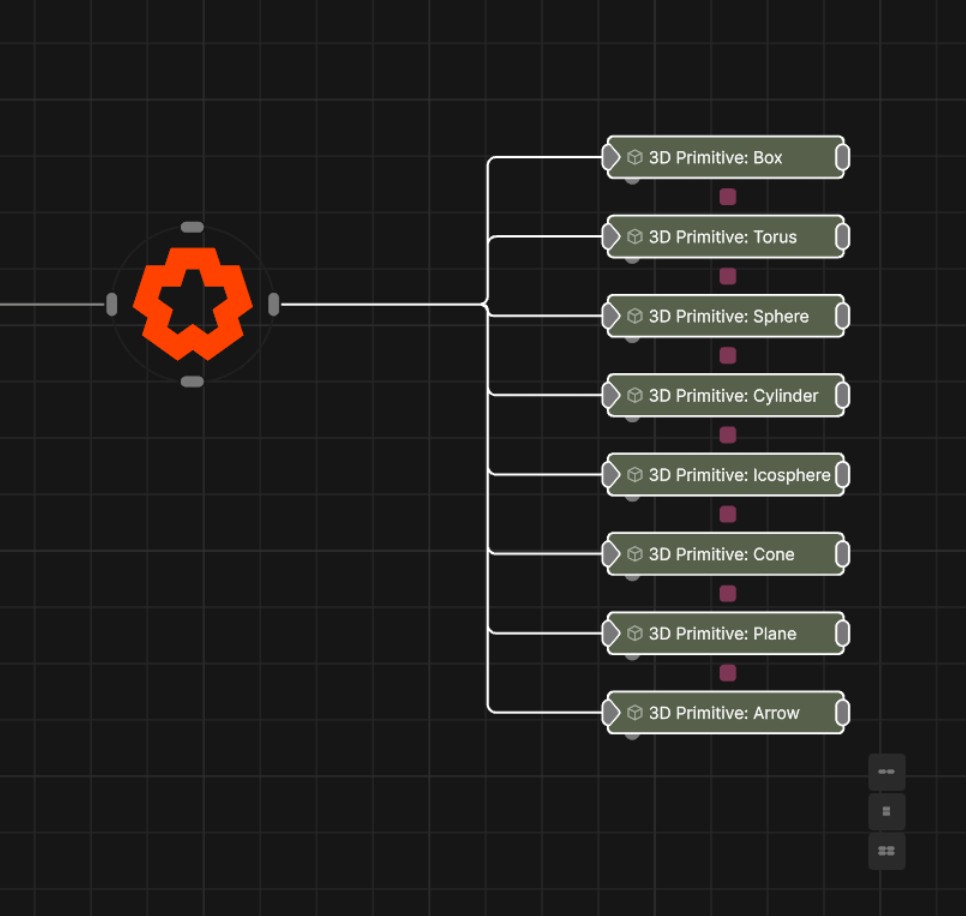
This node generates a 3D primitive mesh, chosen from the meshes Shape Type property. As well as being rendered directly, 3D Primtiives may also be used as an input for various other nodes, including Particle Mesh Emitters, Field Mesh Emitter, Mesh Cloner, and numerous others. A Material Node can also be input to control the meshes material properties.
The 3D Primitive node may be used as a rigid body in a physics system via the Physics Attributes properties. It must be parented under a Rigid Body Root node for physics to be applied.
This node outputs the normal transformation and translation values, but it also outputs geometry which can be modified with Deformer nodes, or used as a mesh sources for nodes which accept mesh connections, such as the Field Mesh Emitter or the Procedural Mesh.
These properties control the 3D transforms of the node. Transforms will generally be inherited by child nodes, although they can be ignored through the Inherit Transform Channels attributes.
| Parameter | Details |
|---|---|
| Position X | The objects position along the local x-axis. |
| Position Y | The objects position along the local y-axis. |
| Position Z | The objects position along the local z-axis. |
| Rotation Heading | The objects rotation around the local y-axis. |
| Rotation Pitch | The objects rotation around the local x-axis. |
| Rotation Bank | The objects rotation around the local z-axis. |
| Scale X | The objects scale along the local x-axis. |
| Scale Y | The objects scale along the local y-axis. |
| Scale Z | The objects scale along the local z-axis. |
Control the inheritance of the transforms from the parent.
| Parameter | Details |
|---|---|
| Position | Toggle inheritance of the Position from the parent. |
| Rotation | Toggle inheritance of the Rotation from the parent. |
| Scale | Toggle inheritance of the Scale from the parent. |
| World Position Only | Inherit the world position from the parent only, rotation and scale will be ignored. Overrides above properties. |
| Inherit Time | Toggle inheritance of time from the parent. |
These properties control the pivot position the object, the point at which the transforms will be applied around.
| Parameter | Details |
|---|---|
| Pivot Mode |
Control where the pivot point is generated for the object.
|
| Pivot Point Selection |
In custom mode, filter the points shown on the bounding box for placing the pivot.
|
| Pivot Position X | In custom mode, directly edit the x position of the pivot. |
| Pivot Position Y | In custom mode, directly edit the y position of the pivot. |
| Pivot Position Z | In custom mode, directly edit the z position of the pivot. |
| Edit Pivot | TODO |
| Dynamic Update | Control whether the changes to the pivot dynamically update the object. |
These properties control the core behaviours of the node.
| Parameter | Details |
|---|---|
| Isolate In Viewport | When enabled, all other objects in the scene will be hidden and only this node will be rendered. |
| Shape Type |
Choose which 3D shape is rendered.
|
| Caps |
Should the extrusion have sealed caps on the ends.
|
| Radius | The radius of the primitive, where appropriate. |
| Inner Radius | Alter the inner radius up to which the affector is fully effective. |
| Bevel Radius | The radius of the rounded corners of the object. |
| Apex Radius | TODO |
| Start Angle | TODO |
| End Angle | TODO |
| Lock Subdivisions To Angles | TODO |
| Size X | Size of the object along the X axis |
| Size Y | Size of the object along the Y axis |
| Size Z | Size of the box along the Z axis. |
| Size Mode |
Choose if the properties define the radius or diameter of the shape.
|
| Subdivisions X | How many subdivisions along the objects X axis. |
| Subdivisions Y | How many subdivisions along the objects Y axis. |
| Bevel Subdivisions | Number of subdivisions used to form the bevel. |
| Box Subdivisions X | Number of subdivisions used for the Box shape on the X axis. |
| Box Subdivisions Y | Number of subdivisions used for the Box shape on the Y axis. |
| Box Subdivisions Z | TODO |
| Subdivisions | The number of subdivisions of each connection line. |
| Origin X |
Set the objects origin point for the X axis.
|
| Origin Y |
Set the objects origin point for the Y axis.
|
| Origin Z |
Set the objects origin point for the Z axis.
|
| Axis |
Set the axis along which the object is aligned.
|
| Flip Direction | TODO |
| Line Thickness | Edit the thickness of the line rendered. Only functions if Use Thick Lines is turned on. |
| Line Array Radial | TODO |
| Arrow Shape |
TODO
|
| Tip Length | TODO |
| Tip Width | TODO |
| Shaft Width | TODO |
| Shaft Length | TODO |
| Depth | TODO |
| Primitive Vertex Count | Shows the original vertex count of the primtiive at generation. |
| Primitive Polygon Count | Shows the original polygon count of the primtiive at generation. |
| Post-Deformer Vertex Count | Shows the current vertex count of the primtiive after all the deformers have been applied. |
| Post-Deformer Polygon Count | Shows the current polygon count of the primtiive after all the deformers have been applied. |
These properties control how the geometry is rendered into the scene.
| Parameter | Details |
|---|---|
| Visible | Control whether the node is visible or not to the scene. |
| Visible To Camera | Is the object visible to the camera. |
| Render As Depth Mask | Renders to depth only, no colour. |
| Visible In Bounces | Is the object calculated in bounce related render properties such as reflections. |
| Casts Shadows | Toggle whether the object can cast shadows. |
| Per Object Composite Alpha | Overwrites the alpha channel beneath the object, giving simple effect of transparency. Best used when the mesh won’t overlap with other objects, as other meshes will not be seen through the mesh. |
These properties control how the UVs of the mesh are transformed when output for the UV camera. Useful for arranging multiple objects to be output for the same UV Camera.
| Parameter | Details |
|---|---|
| UV Scale X | Scale the mesh UV along the X axis. |
| UV Scale Y | Scale the mesh UV along the Y axis. |
| UV Offset X | Move the mesh UV along the X axis. |
| UV Offset Y | Move the mesh UV along the Y axis. |
| Parameter | Details |
|---|---|
| Show Metrics | Displays information about the mesh geometry. |
These properties control the behavious of the object in a Physics System.
| Parameter | Details |
|---|---|
| Static Friction | How much resistance there will be for rigid bodies that are at rest relative to each other to begin moving. |
| Friction | How much other rigid bodies will be able to slide along side this rigid body. When two rigid bodies of different frictions interact, the minimum value is used. |
| Bounciness | How much this rigid body will bounce off of other rigid bodies in the scene. |
| Density | The density of the rigid body. The density is scaled by the area of the shape to determine the mass of the body. |
| Dynamics Mode |
How the object is used in a physics simulation. Parenting to a Physics Root node node must be done for any physics simulations to occur.
|
| GPU Transform Only | If selected, the transform of the body is maintained on GPU only. This reduces latency and increases performance but means that parenting to the object, e.g. using it to transform lights or emitters, will not work. |
| Rigid Body Shape |
The shape of the rigid body used for physics simulation. Often times, a simpler approximation of a mesh can be used for significantly improved performance.
|
| Rigid Body Convex Hull Mode |
Determines the convex hull shape generation used to wrap around the node’s geometry. only functions if the Convex Hull shape is selected in the Rigid Body Shape.
|
| Rigid Body Chunks Mode |
Set whether to treat the object as one single rigid body, or whether to calculate physics for each chunk.
|
| Max Chunks | When using ‘Multi Body’ chunk mode, set the maximum amount of chunks that can be calculated. Useful for performance optimisation. |
| Mass Center X | Adjust the object’s center of mass along the X axis |
| Mass Center Y | Adjust the object’s center of mass along the Y axis |
| Mass Center Z | Adjust the object’s center of mass along the Z axis |
| Advanced | TODO |
| Collision Radius | The radius of collision shape if applicable. |
| Collision Mode |
Mode for calculating collision if applicable.
|
| Rigid Body Sphere Radius | TODO |
| Rigid Body Box Size X | TODO |
| Rigid Body Box Size Y | TODO |
| Rigid Body Box Size Z | TODO |
| Bake Physics Transforms | Bake physics transforms so they are no longer dynamic, but reliably playback and are more performant. |
| Baked Transform | Select the baked physics transform. |
These properties add options for drawing all the edges of the mesh as lines. Useful for rendering wireframe effects.
| Parameter | Details |
|---|---|
| Lines Visible | Control whether lines are rendered to the scene from the geometry. |
| Lines Alpha | Change the alpha transparency value of the lines, making them appear see-through. |
| Colour | Change the colour value of the lines. |
| Use Vertex Colours | Colour lines based on the vertex colours of the geometry. |
| Blend Mode |
How the object lines blends with the rest of the content in a 3d scene. See Blend Modes for details.
|
| Thick Lines | Allow the lines to rendered with thickness, for line effects which can be accurately anti-aliased. |
| Thick Line Width | Control the thickness of all the lines. Only functions with Thick Lines enabled. |
| Hide Back Face Lines | Hide the lines generated from polygon faces facing away from the camera, where only the back faces of geometry can be seen. |
| Lock Width | Lock the line width to be a consistent width regardless of distance from the camera. Only functions with Thick Lines enabled. |
| Show Silhouette Lines | Draws lines along the edges of the object relative to the camera. |
| Show Normal Difference Lines | Draw a line along the edges of the mesh, depending on the angle difference between their mutual faces. |
| Show Unshared Lines | Draw lines along all edges of the shape. |
| Show Other Lines | Show all the lines for each edge of the mesh. |
| Unshared Lines Weight | Control the strength of the unshared lines. |
| Silhouette Lines Weight | Control the strength of the silhouette lines. |
| Normal Difference Lines Weight | Control the strength of the lines generated along the normal angles. |
| Other Lines Weight | Control the strength of the lines for each edge in the mesh. |
| Line Normal Difference Angle | Change the threshold angle between two face normals that will generate a line along their common edge. Only functions with Show Normal Lines enabled. |
| Line Normal Fade Sharpness | How much the drawn normal lines will fade away the closer the edge angle is to the Line Normal Difference Angle. |
| Line Depth Bias | Exaggerate the width of the lines based on the distance to the camera. not functional with Lock Width enabled. |
| Line Silhouette Fade Sharpness | How much the drawn silhouette lines will fade away based on the size of the edge angle to the camera. |
Preview the objects material in the viewport.
| Parameter | Details |
|---|---|
| Material Preview | Preview the objects material in the viewport. |
These properties control the core behaviours of the material using Physically Based Rendering (PBR) properties from a A Bidirectional Reflectance Distribution function. Changing the properties below can make a material appear more reflective, more dirty, or add more detail to the material surface. By using textures (either through the relevant inputs, or in the texture section), each of these properties can be modulated over a surface, for more complex material effects.
| Parameter | Details |
|---|---|
| Colour | The colour of the material. |
| Brightness | The brightness of the material. |
| Specular Intensity | The intensity of the specular reflection. |
| Specular Colour | The colour of the specular reflection. |
| Colour Map -> Specular Colour | Use the input colour map as the specular reflection colour. |
| Specular Anisotropy | Controls the anisotropy of the specular reflection. |
| Specular Falloff | Controls the falloff of the specular reflection. |
| Diffuse Fresnel | Controls the fresnel effect on the diffuse reflection. |
| Metallicness | Controls the metallicness of the material. |
| Roughness | Controls the roughness of the material. |
| Normal Map Mode |
Changes the format of the input normal map.
|
| Emissiveness | How much of a glow is emitted around the object. |
| Emissive Scattering | Controls how much Emissive lighting is scattered in the scene. |
| Emissive Lights Scene | Controls how much Emissive lighting contributes to lighting the scene. |
| Use Displacement |
Enables the use of displacement mapping for the material. *Requires an input displacement map.
|
| Opacity Mode |
Controls the opacity mode of the material, and how it blends with the scene.
|
| Translucency |
Controls the translucency mode of the material.
|
| Diffuse Lightmap |
Enables an input diffuse lightmap for the material.
|
| Ambient Occlusion |
Enables the input ambient occlusion map of the material.
|
Settings related to the textures used in the material.
| Parameter | Details |
|---|---|
| Colour Texture | Defines the base color of the material’s surface. It represents the surface color under neutral, uniform lighting. |
| Diffuse Map | Specifies the color of light that scatters off the surface in all directions. It is functionally similar to the Colour Texture and is a core component of a material’s appearance. |
| Specular Map | Controls the color and intensity of shiny reflections (specular highlights). Brighter areas on the map indicate a more reflective and shinier surface. |
| Emissiveness Map | Determines which parts of a material appear to glow or emit their own light. Brighter values cause the surface to act as a light source. |
| Metallicness Map | A grayscale map to define how ‘metal-like’ a surface is. White values represent pure metal, while black values represent non-metals. |
| Roughness Map | A grayscale map that controls the roughness of the surface. Black represents a smooth, mirror-like surface with sharp reflections, while white represents a rough surface with blurry, diffuse reflections. |
| Normal Map | Adds surface detail like bumps and scratches without adding more polygons to the model. It simulates how light would interact with a more complex surface, creating the illusion of depth. |
| Displacement Map | Physically displaces the vertices of the model’s geometry based on the map’s values. Unlike a Normal Map, this creates real geometric detail that affects the model’s silhouette. |
| Alpha Map | A grayscale map that controls the transparency of the material. Black areas are fully transparent, white areas are fully opaque, and gray values create semi-transparency. |
| Ambient Occlusion Map | Adds subtle, soft shadows to areas that are occluded from ambient light, such as creases and crevices. This enhances realism and adds perceived depth to the model. |
| Subsurface Colour Map | Defines the color of light after it has scattered beneath the surface of a translucent material, such as skin, wax, or marble. |
| Subsurface Weight Map | Controls the intensity of the subsurface scattering effect across the material, defining how much light penetrates and scatters within the surface. |
| UV Texture Filter Mode |
Determines the algorithm used for sampling texture pixels when viewed at different angles and distances.
|
| Diffuse Map -> AO | A setting to use the Diffuse or Colour map to contribute to the Ambient Occlusion calculation, often darkening areas based on the base color. |
| Texture Mip Bias | An offset that adjusts which mipmap level is used for a texture. Negative values can sharpen distant textures, while positive values can blur them. |
These properties control how the material applies to the mesh UVs.
| Parameter | Details |
|---|---|
| Colour Texture UV |
Select the UV for the Colour Texture.
|
| Diffuse Map UV |
Select the UV for the Diffuse Map Texture.
|
| Specular Map UV |
Select the UV for the Specular Map Texture.
|
| Emissiveness Map UV |
Select the UV for the Emissiveness Map Texture.
|
| Metallicness Map UV |
Select the UV for the Metallicness Map Texture.
|
| Roughness Map UV |
Select the UV for the Roughness Map Texture.
|
| Normal Map UV |
Select the UV for the CoNormal Map Texture.
|
| Displacement Map UV |
Select the UV for the Displacement Map Texture.
|
| Alpha Map UV |
Select the UV for the Alpha Map Texture.
|
| Ambient Occlusion Map UV |
Select the UV for the Ambient Occlusion Map Texture.
|
| Subsurface Colour Map UV |
Select the UV for the Subsurface Colour Texture.
|
| Subsurface Weight Map UV |
Select the UV for the Subsurface Weight Texture.
|
| UV Scale X | Scale the UV texture along the X axis. |
| UV Scale Y | Scale the UV texture along the Y axis. |
| UV Offset X | Offset the UV texture along the X axis. |
| UV Offset Y | Offset the UV texture along the Y axis. |
| Diffuse UV Scale X | Scale the Diffuse UV texture along the X axis. |
| Diffuse UV Scale Y | Scale the Diffuse UV texture along the Y axis. |
| Diffuse UV Offset X | Offset the Diffuse UV texture along the X axis. |
| Diffuse UV Offset Y | Offset the Diffuse UV texture along the Y axis. |
| Texture Wrap Mode U |
Controls how textures used by the material are wrapped when the U value range exceeds 0 to 1.
|
| Texture Wrap Mode V |
Controls how textures used by the material are wrapped when the V value range exceeds 0 to 1.
|
| Diffuse Texture Filter Mode |
Controls how textures used by the material are filtered.
|
| Diffuse Texture Wrap Mode U |
Controls how textures used by the material are wrapped when the U value range exceeds 0 to 1.
|
| Diffuse Texture Wrap Mode V |
Controls how textures used by the material are wrapped when the V value range exceeds 0 to 1.
|
| UV Remap Filtering | Enables filtering for remapping UV’s. Only functions with eligible textures. |
These properties control the rendering settings for the material.
| Parameter | Details |
|---|---|
| Lit | Determines if the material is affected by lights in the scene. When disabled, the material appears fully lit by its own colour and texture, regardless of scene lighting. |
| Reflections Mode |
Controls how the material generates reflections from its surroundings.
|
| Shadows |
Defines how the object interacts with shadows in the scene.
|
| Render Visibility |
Controls the object’s visibility to different types of rays in the renderer, which is useful for advanced effects.
|
| Raytracing Settings |
Determines whether the material uses the scene’s global raytracing depth settings or custom values.
|
| Max. Diffuse Depth | Limits the number of times a ray can bounce off diffuse surfaces, affecting indirect lighting quality. |
| Max. Glossy Depth | Limits the number of times a ray can reflect off glossy or specular surfaces. |
| Max. Refraction Depth | Limits the number of times a ray can pass through refractive (transparent) surfaces. |
These properties control a rim lighting effect, a Light which sits just behind the subject and adds a wrapping of liht around the mesh edges.
| Parameter | Details |
|---|---|
| Polygon Sidedness |
The orientation of the polygon’s faces.
|
| Flip Polygons | Flips the orientation of the polygon’s faces. |
| Smoothing Angle | The angle difference used to determine a hard edge or a soft curve. |
| Wireframe | Displays the material’s geometry as a wireframe. |
These properties control a rim lighting effect, a Light which sits just behind the subject and adds a wrapping of liht around the mesh edges.
| Parameter | Details |
|---|---|
| Rim Lighting |
Simulates Rim Lighting on the material with respect to the camera.
|
| Glow | Controls the glow of the Rim Lighting. |
These properties allow you to control how vertex colours are applied to meshes, and to other parts of the PBR pipeline.
| Parameter | Details |
|---|---|
| Vertex Colours - Apply To Colour |
Set how the vertex colours apply to the colour of the mesh.
|
| Vertex Colours - Apply To Alpha |
Set how the vertex colours apply to the alpha of the mesh.
|
| Vertex Colours - Apply To Roughness |
Set how the vertex colours apply to the roughness of the mesh.
|
| Vertex Colours - Apply To Metallicness |
Set how the vertex colours apply to the metallicness of the mesh.
|
| Vertex Colours - Apply To Emissiveness |
Set how the vertex colours apply to the emissiveness of the mesh.
|
| Parameter | Details |
|---|---|
| Normal Map Intensity | TODO |
| Invert Normals | Flip the normals of each face, so the lighting is tested against the inside face. |
| Displacement | How much the deformer displaces the original mesh. |
| Displacement Offset | Adds an initial offset to the displacement. |
| Displacement - Use Polygon UVs | TODO |
| Alpha | Set the alpha amount of the material |
| Blend Mode |
Change how the material once added to an object blends with the scene. Only functions with Alpha Mode for details.
|
| Alpha Sort Bias | Biases the alpha sort in order to make it render in front or behind other transparent objects. |
| Output Alpha In GBuffer Composite | Sends the alpha to the gbuffer composite pass. |
| Refraction IOR | TODO |
| Aberration | TODO |
| Absorption | How much light is absorbed by the material as light passes through it. |
| Absorption Colour | Colour to use for absorption. |
| Subsurface Weight | Weight of the subsurface scattering effect. |
| Subsurface Scatter Radius | Radius of the subsurface scattering effect. |
| Diffuse Coat | TODO |
| Baked Diffuse Intensity | TODO |
| Shadow Catcher Colour | Set the colour of the material when “Shadows” is set to “Shadow Catcher”. |
| Rim Lighting Use Material Colour | TODO |
| Rim Lighting Colour | TODO |
| Rim Lighting Intensity | TODO |
| Rim Lighting Falloff | TODO |
The properties control the time at which the node is active. See Timeline for editing time segments.
| Parameter | Details |
|---|---|
| Duration |
Control the duration of the node’s time segment.
|
| Node Time | The custom start and end time for the node. |
| Duration (Timecode) | The length of the node’s time segment (in time). |
| Duration (Frames) | The length of the node’s time segment (in frames). |
| Time Segment Enabled | Set whether the node’s time segment is enabled or not in the Timeline. |
| Name | Description | Typical Input |
|---|---|---|
| Material | Override the default material with a material node. | Materials |
| Transform Modifiers | Apply the transforms of another node to this node. | Null |
| Target Node | Modifiy the rotations of the node to always direct the z axis towards the input. | Null |
| Local Transform Override | Apply the transforms of another node to this node, relative to its parent. | Null |
| Parameter Value Array | Used to set the parameters of the node using a float array. | Parameter Array |